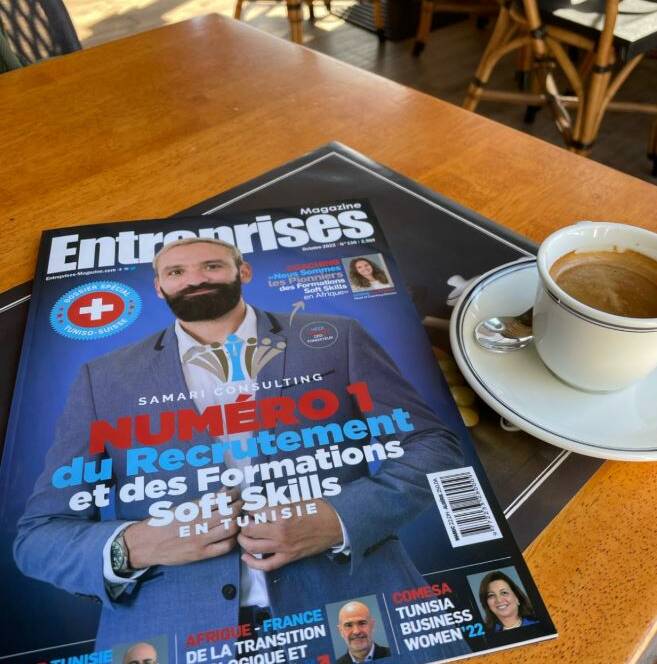
Discovering the world of recruitment and human resources management in Europe within a major firm, developing experience on the African continent, and breaking into the field in Tunisia by launching his own company specializing in headhunting and HR expertise—such is the journey of Hedi Samari, CEO of Samari Consulting.
A seasoned professional in recruitment and human capital management, he has given his mission dimensions that go beyond executive placement to encompass the redesign and implementation within companies of an entire vision and strategy for developing human resources and building a mindset that promotes effective communication, empathy, and the sharing of knowledge and experience in a healthy and balanced atmosphere. Together with Sabine Bastisch, Director of HR Services and Soft Skills Development at Samari Consulting, they share their vision with us…
Tell us about your background
Hedi Samari: My career in human resources began in London at a large international recruitment firm. After completing my university studies in history, I contacted the firm to look for my first job, and they then offered me the opportunity to join their team and develop within their structure. I gained experience in recruitment in various fields: finance, technology, industry, etc. within the entire extended network for five years before embarking on a new professional adventure in 2012. As part of the expansion of the firm’s network, particularly in Africa, management asked me to oversee the project to open a new desk for the Maghreb. Motivated by the entrepreneurial aspect of the opportunity and the work in French-speaking African countries, I accepted the challenge and invested myself in executive headhunting for three years. In 2015, for family reasons, I decided to settle in Tunisia and continue on the path of entrepreneurship by launching my own company specializing in headhunting.
Sabine Bastisch: I am originally from Germany where I studied Business Arabic and international management. I have always been passionate about learning languages and different cultures. This love led me to live in Tunisia and study at Bourguiba School. I also spent a period of my life in Qatar and Jordan before deciding to return to Tunisia. My professional experiences have diversified through different companies specializing in hospitality, commerce, etc. What interested me in all these experiences was indeed this complex world of human relations and how to overcome the interaction and communication problems that can arise. The challenge of the human and relational aspect was the common denominator of all the companies I worked with. My curiosity pushed me to take an interest in this problem by trying to understand the reasons behind all this and by proposing adequate solutions, and that is where I found the Samari Consulting firm as an opportunity to break into this field.
What are the main services your company offers?
Hedi: We work mainly in three areas: the first, for which we are initially known, is headhunting executives, directors, and top managers for multinationals, SMEs, and family businesses. The second is soft skills development. The third area, which completes what we offer our clients, is HR strategy consulting, which includes SWOT analysis of a company’s HR activity and the implementation of a range of projects that improve the overall performance of human resources, better structure processes and procedures, and improve employee satisfaction and turnover rates.
Sabine: This choice is motivated by the observation we made through the managerial experiences of our clients and the specificities of different professional environments. In fact, today, the Achilles heel of most economic entities is not the technical aspect among staff, but rather the human aspect, interpersonal skills and culture. This very important aspect weighs heavily on the continuity of the company’s operations and its rate of growth and development, since it directly impacts the social atmosphere and team harmony and, by extension, the success of the project. Aware of the importance of this aspect, companies turn to our firm to help them resolve communication problems and effectively manage conflicts within their teams through the design of tailor-made support programs based on a detailed diagnosis and a one-to-one approach that will meet the diverse needs of our clients. Our address book is quite extensive, including Tunisian and other foreign companies established in Tunisia.
Tell us more about your Human Resources Consulting services.
Hedi: Yes, and this is our third mission. In addition to the companies that contact us for executive recruitment and the implementation of coaching and soft skills development programs, we also provide our clients with HR consulting services. These encompass the entire human resources management system: developing policies and strategies, redesigning procedures and work tools, improving team culture, staff retention, etc. Our work is based on a comprehensive approach that addresses all the elements necessary for effective human resources management. Today, our role goes beyond the recruitment aspect to encompass the overhaul of the entire HR system through a detailed diagnosis of the company’s internal environment and its core values, its recruitment history, staff development and success, and turnover rates. This 360° view allows us to clearly identify our client’s HR profile and propose appropriate solutions that meet their needs.
Which companies use headhunting services the most?
Hedi: First and foremost, multinationals rely most heavily on headhunting, given their work processes and standards, and their very high expectations. We work with this category of clients to replace executives and top managers. Today, we are increasingly sought after by SMEs and family businesses, which represent the core of the economy. These companies, which are undergoing profound changes with the rise of new generations of managers and faced with the new paradigm of change imposed by the complexity of the economic and operational environment, generally require real HR support. Carrying out a mission to redesign the human resources management system for this type of company represents a real challenge, given the specificities of their internal environments and their culture characterized by a high resistance to change. The third category of clients is startups, even at an embryonic stage, which are looking for solid skills capable of developing companies and opening up great growth prospects.
Can a start-up afford this type of services?
Hedi : Startups that have raised funds and need to recruit talent to expand into other markets as part of their growth strategies rely on our services. For other startups, using recruitment firms is an investment they make from the outset to build their business on solid foundations.
Sabine : Targeting the right profiles through specialized companies in this area is seen by many entities as a profitable investment in the medium and long term and not as an expense: the development and growth of the business inevitably involves the choice of qualified personnel and managers with good managerial skills.
What are the most sought-after profiles in the market today?
Hedi: We are often looking for senior executives such as human resources directors, finance directors, CEOs, DGAs and recently in the IT field, following the haemorrhage that has taken place in recent years.
Sabine: Generally, the profiles most sought after by companies are creative individuals who add value and are capable of providing the right solutions to the problems encountered by projects. These profiles should possess a very strong capacity for resilience and innovation, as well as a sense of adaptability and versatility. These qualities are useful for creating change.
As a Human Resources Consulting firm, what is your added value?
Hedi: We believe our greatest advantage over the competition is agility. Our holistic approach to work is based on passion and availability. We work in an agile manner, adapting to our clients’ needs. In our assignments, we ensure we invest heavily in everything we do, while constantly listening to companies through mutual and constructive exchanges.
Sabine: We address all client needs by offering a comprehensive and diverse range of services that encompass recruitment, coaching, HR consulting, and leadership development. Our intervention is not limited to the theoretical aspect of things; we help companies put managerial concepts and soft skills into practice to make our contribution effective.
What is the success factor of this type of support?
Hedi: We believe the answer lies in listening to our clients and honoring our commitments. Our dedicated work and customer satisfaction have earned us a portfolio of over 350 clients across a variety of sectors. We engage with our clients as partners, not as a service provider.
Sabine: This partnership is based on a commitment to quality, confidentiality, responsiveness and a sense of adaptation to the internal environment, particularly for companies with a particular professional culture that requires a processing approach and solutions adapted to their specificities.
For executives and managers, what are their expectations towards the professional environment?
Hedi: Generally, executives seek a supportive environment where there is a desire for change and added value. They are hostile to rigidity and a lack of professionalism. Through our experience, the success of integration for the majority of executives depends on the existence of a healthy professional environment and a managerial culture based on mutual respect, learning, and collective development. In our missions, we ensure collaboration with both the candidate and the company, trying to create a kind of synergy between the two parties so that each of them benefits by emphasizing the importance of respect, clarity, and mutual understanding. This core of values helps to sustain the links between the various stakeholders in this sphere and to achieve a successful client experience for our firm.
For HR consulting, what are the biggest challenges companies face today?
Sabine: We believe that the biggest challenge companies face is indeed the lack of effective communication, and this observation has become very common across different sectors. We place a strong focus on this crucial aspect of human behavior within the company, because it represents one of the pillars of the success of each project: if we cannot communicate and understand each other well, we will not be able to succeed in a project. Sometimes, the company implements a very efficient system thinking it will solve work problems. However, the lack of adaptation to change, the divergence of visions, the lack of clear and effective communication around this new system and the inability to manage the conflicts generated cause all the efforts made to create change to fail.
How do you view the turnover problem that a large number of companies suffer from?
Hedi: We fully agree that brain drain is a major problem for companies in Tunisia, especially those operating in the IT sector. It must be admitted that we will never be able to stop this scourge permanently. However, we could design and implement measures to mitigate the harmful impact of this phenomenon, such as developing integration and retention strategies and establishing mechanisms to retain employees and entrench the culture and sense of belonging to the entity. For example, good onboarding has become very critical today and a very important parameter in the success of employee integration and the effectiveness of human resources management. Five years ago, this phenomenon did not enjoy the same value within companies. Making efforts to offer the best employee experience is essential for effective human resources management and the development of the skills necessary for business continuity and success. The company culture should be based on a foundation of human and professional values promoting the development of human capital and the emergence of generations of loyal employees with a sense of belonging.
For candidates and companies looking for profiles, what advice would you give to improve their attractiveness?
Sabine: The first tip is branding, and this applies to both candidates and companies. For candidates, it must be said that today’s job seekers have many more options than ever before, thanks in part to the digital presence. These channels represent an opportunity for employees to promote their image, find opportunities, and open up promising career prospects. We also recommend always seizing opportunities to organize and participate in conferences and events to expand your contact list and establish valuable connections and networking opportunities.
Hedi: For a company, it’s the work on its name and its internal professional environment that promotes its image in the job market. Working well on this aspect can significantly improve its attractiveness. A high turnover rate is a sword of Damocles for companies, and therefore working on this scourge should be a priority for them. When we work with our clients, we always start by developing a SWOT analysis to understand the root cause of the problems and act accordingly by implementing appropriate measures.
How can you help people who are looking for a career change?
Hedi: We are currently witnessing this phenomenon in all sectors, particularly in order to integrate the IT field where professional prospects are promising. We believe that this is a normal and healthy phenomenon. Our advice regarding the management of this reconversion includes, among other things, the follow-up of academic paths such as master’s degrees and MBAs. Also, and especially in the IT field, there are centers that offer short-term training courses for learning development and programming. Technicality is important in the reconversion process, and in order to increase the chances of opening new horizons, we also recommend working on recognized certification, particularly PMP certificates.
In the coming years, which soft skills will be most in demand?
Sabine: We believe that the most important interpersonal skill, and the one that will be most in demand, is empathy. Being aware of this and being emotionally intelligent will help develop other soft skills such as communication, adaptability, and teamwork.
What are your projects?
Hedi: We are focusing on consolidating our HR expertise. Through our work, we have seen a significant increase in demand in this area. People are becoming increasingly aware of the importance of soft skills in their daily work. This aspect is no longer a fad, but has become a necessity for career progression, and that is why we see people investing in their personality and behavior to succeed in their careers and advance. Our mission will be to help talent develop through comprehensive support and a One Stop Solution intervention. We are agile and adapt to the changes and dynamics of the job market. The human resources profession is facing the emergence of several phenomena such as artificial intelligence, which could significantly impact human capital management within the company. Solving these constantly evolving issues leads us to adopt a flexible, agile, and market-driven work approach.
A final statement.
Hedi: We believe that the key to effective human resources management lies in the ability to listen. Take the time to listen to your employees! Opening the doors to dialogue and sharing helps ensure fluid communication within the team. Ensuring this aspect is a crucial step in improving the work environment. It is important to establish a culture of sharing feedback and not hesitate to implement a diagnostic system for all elements of the human resources management system in order to evaluate its effectiveness and level of satisfaction. We must not fall into the trap of using a lack of resources as an excuse not to move forward on a project. Taking the first step, even with limited resources, is always a motivating act for the team. We should work on mobilizing all members around a project or a vision, and then the resources will follow.