Interview with Hedi Samari, CEO and Founder of Samari Consulting.
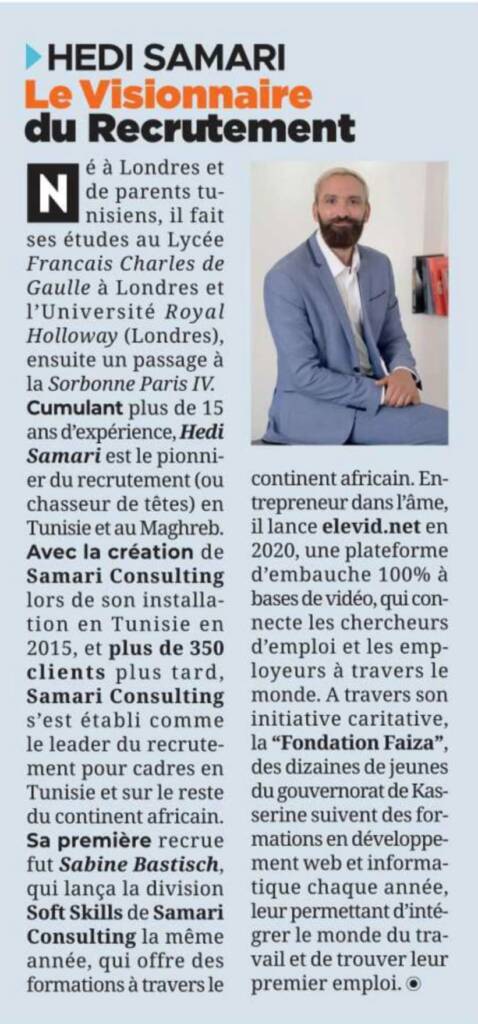
Born in London to Tunisian parents, he studied at the Lycée Français Charles de Gaulle in London and Royal Holloway University (London), followed by a stint at the Sorbonne Paris IV.
With over 15 years of experience, Hedi Samari is a pioneer in recruitment (or headhunting) in Tunisia and the Maghreb.
With the creation of Samari Consulting when it moved to Tunisia in 2015, and more than 350 clients later, Samari Consulting has established itself as the leader in executive recruitment.
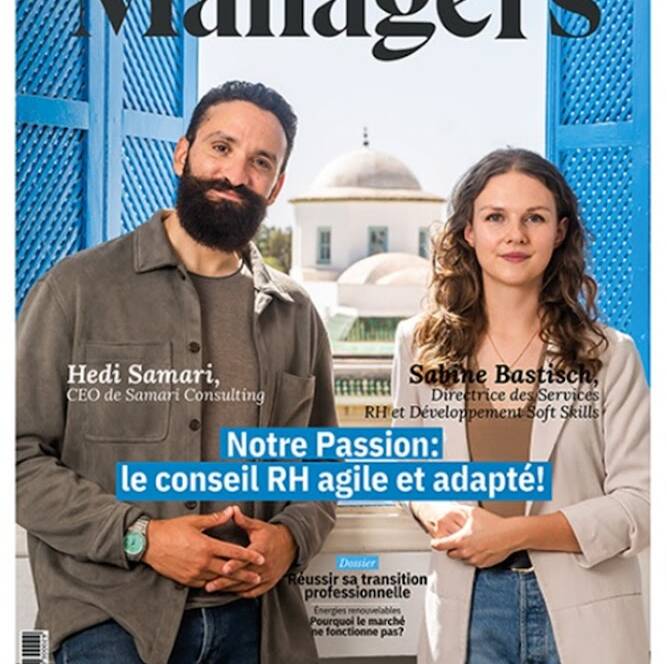
Its first recruit was Sabine Bastisch, who launched Samari Consulting’s Soft Skills division that same year.
7 years of existence for Samari Consulting, let’s briefly look back at the key dates of this company?
Samari Consulting was founded in 2015, following my move to Tunisia, which was initially motivated by family reasons. As you know, 2015 was a rather difficult year for Tunisia, with several tragic events that deeply affected us and, subsequently, was also marked by significant economic challenges.
Despite these circumstances, I still believed in the strong potential of Tunisian talent and skills, and in the years that followed, Samari Consulting was able to develop its reputation in the African market, with more than 350 diverse clients. We collaborate with family businesses as well as large international groups. In addition, we also enjoy supporting startups and helping them write their success stories.
During these seven years, we have, of course, also developed the services we offer our valued clients, which today also include Soft Skills Coaching and HR strategy consulting.
Listening to our clients and engaging with the professional ecosystem is essential to us, and our presentations at conferences, universities, and in the media (radio, TV, podcasts, etc.) always present an excellent opportunity to share expertise and keep us abreast of the latest developments in the market.
Today, in 2022, I am very grateful to my team for this professional adventure, with all its challenges and successes. I also thank our loyal clients who trust us and appreciate our approach of offering them a boutique service, highly personalized and with a strong spirit of partnership.
With Samari Consulting, you introduced the concept of headhunting, a more direct approach, to the Tunisian market. How did the business ecosystem and job seekers respond to this new approach, and how have attitudes changed since then?
I’ve been working in the Tunisian market since 2012. At the time, I was manager and then director of French-speaking Africa at a headhunting firm in London. Although there were a few local headhunters, the concept wasn’t well known in the market.
With the creation of Samari Consulting in 2015, we were able to contribute to the development of the concept of headhunting, which is now well established in Tunisia. I would even say that the direct approach and the importance of human relationships in this profession are things that work very well in the local culture, as they allow us to establish a relationship of trust and discretion with our candidates as well as our clients.
We’ve also noticed that the mindset among family businesses in Tunisia is changing, and this change could also be linked to a generational transition. Generally speaking, it’s safe to say that today’s family businesses are open to external recruitment and are highly motivated to integrate new talent into their organizations in order to achieve their ambitious national and international goals. Moreover, Samari Consulting has followed a perhaps somewhat “atypical” path, focusing on local recruitment, as we have always sought to be a kind of counterbalance to the brain drain that is weighing heavily on several industries in Tunisia. We believe in Tunisia and its potential to nurture its talent locally.
You’ve added Soft Skills Coaching and support for companies in developing their teams’ interpersonal skills to the range of services you offer your clients. How can this specialty impact professional careers today?
Samari Consulting’s Soft Skills Coaching division began operations under the leadership of Sabine Bastisch, our Head of Coaching Division, at the end of 2015. Initially, the concept of soft skills, or non-technical skills, was not well known in the market.
However, we were contacted by several clients who noticed challenges with interpersonal relationships within their teams. That is, there were factors preventing them from succeeding that were unrelated to their professional know-how or expertise.
Following our discussions with them, we decided to implement a fully customized service to meet their need for personalized support in developing their soft skills.
In general, soft skills now represent an integral part of each talent’s skill set, and they also have the power to develop corporate culture and improve talent retention. We can say that Sabine is a pioneer in the field of Soft Skills coaching in Tunisia.
What makes a headhunting mission successful? What advice do you give clients and candidates to ensure they give themselves the best chance of hiring the best candidate or landing the job?
All parties involved—the client, the candidate, and the headhunter—play a crucial role in the success of a headhunting mission. It’s important that, as an intermediary, we clarify everyone’s responsibilities and ensure that both the client and the candidate understand how we can support them and facilitate the process. This begins with drafting the job description and ends with negotiating the employment contract, signing it, the candidate’s resignation (a very sensitive part of the process), and finally, follow-up once the candidate has started in their new position.
Our clients can ensure a successful mission by sharing information and engaging in ongoing dialogue with the headhunting team, so that we can ensure clear and centralized communication.
As headhunters, we can do our job best when we are kept up-to-date on all recruitment-related developments.
Furthermore, we can best support our candidates when they are communicative and honest throughout the process. If they have any questions or concerns, which is completely normal when it comes to a decision as important as changing jobs, they are always welcome to come and talk to us, even if they fear we won’t be satisfied with their decision or might disagree with them.
Communication remains the most important thing, and rest assured that we will never take “no” personally—business is business!
How are you dealing with the current issues of brain drain and post-Covid budget cuts?
I think it’s safe to say that you can’t retain someone who has already decided to leave the country.
However, locally, employers can and continue to create supportive work cultures that value professional growth and development while offering interesting challenges in attractive work environments.
As for budget cuts, they are, of course, a reality in the current economic climate, especially post-Covid. From what we’ve seen in the market, companies need to be more strategic in their recruitment plans. Despite all the challenges, our clients share with us that this also represents an opportunity for them to rethink their old ways of doing business and innovate.
In Tunisia, the boundaries between professional and private life can sometimes blur, making it increasingly difficult to balance the two. How do you manage this, and how does it affect your work?
I think there are both pros and cons to this, and everyone has to develop their own way of managing both, especially as an entrepreneur.
For example, I’m very grateful for the quality of the relationships I’ve been able to build with clients and candidates in this market. In Anglo-Saxon markets, professional relationships often remain more superficial and distant, which in turn leads to less mutual understanding. So, this is something I really appreciate about the local work culture.
At the same time, it’s true that the boundaries between work and private life can blur a bit, and we end up working 24/7. I think the strategy that works best for me personally is to maintain a balance between a high level of responsiveness to our projects (including our team, clients, and candidates), while also creating enjoyable moments.
For example, sometimes a change of location can do wonders—and Tunisia has so many beautiful places to offer. Holding a meeting in a cozy cafe or sending emails from our office balcony, overlooking the historic center of La Marsa Saf Saf, can really make my day special.
Finally, spending quality time with family and playing sports is very important and enjoyable.